Georgia’s Black Sea Coast by Campervan: From Tbilisi to Batumi
Most people who come to Georgia head north — to Kazbegi, to the mountains, to the dramatic Military Highway. And they’re right to. But the road west tells a completely different story.
Where the north is granite and glacier, the west is green. Deeply, almost unreasonably green. The further you drive from Tbilisi, the more the landscape softens — pine forests give way to subtropical jungle, the air gets warmer and wetter, and somewhere around Kutaisi you realize you’ve crossed into a completely different version of the same country.
And at the end of it all, the Black Sea.
This route — Tbilisi to Batumi via Borjomi, Bakuriani, and Kutaisi — is one of the great campervan journeys of the Caucasus. It has thermal springs, medieval cave cities, ancient monasteries, a working botanical garden on a cliff above the sea, and dozens of wild camping spots where you won’t see another soul.
Here’s how to drive it.
The Route at a Glance
Tbilisi → Borjomi → Bakuriani → Kutaisi → Kobuleti → Batumi
Total distance: approximately 350 km by the main road, more if you take the scenic detours — and you should.
You could drive it in a single day if you wanted to. But why would you? Allow at least five days to do it properly, and seven if you want to linger in the places that deserve it.
Day 1 — Tbilisi to Borjomi (150 km)
Leave Tbilisi in the morning and head southwest on the main E60 highway. The first stretch is fast and unremarkable — save your attention for what comes after the town of Gori, where the road begins to follow the Mtkvari River into the mountains.
Borjomi is Georgia’s most famous spa town, known throughout the former Soviet Union for its naturally carbonated mineral water — the same water that comes in those distinctive green bottles you’ll find in every shop and restaurant across the country. The water emerges from the ground at around 38°C and has been flowing here for centuries.
Spend an afternoon in Borjomi-Kharagauli National Park — one of the largest protected areas in the Caucasus, with hiking trails through ancient beech and fir forest. The town itself is pleasant without being spectacular: a long central park, the mineral spring pavilion, a few good cafés.
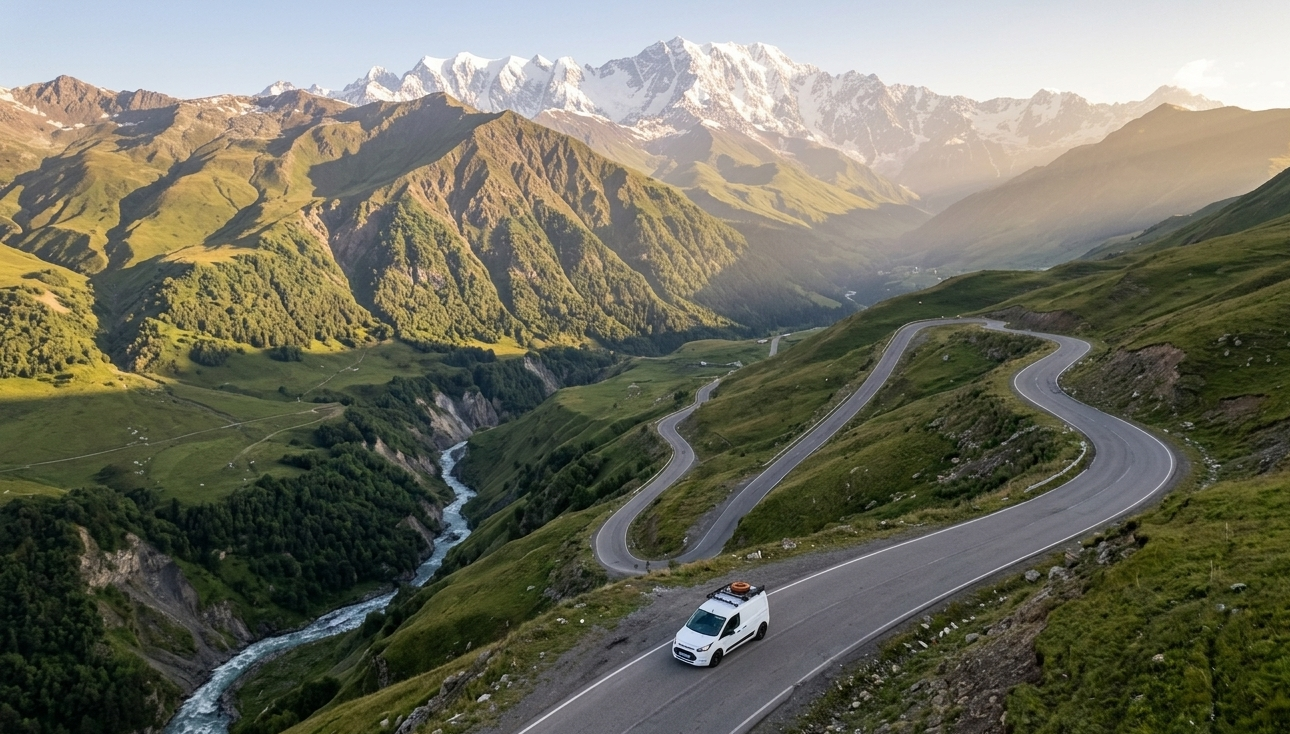
Detour worth taking: Drive up to Bakuriani — a mountain resort town about 30 km from Borjomi up a winding switchback road. In summer it’s quiet and beautiful, full of alpine meadows and old Soviet-era chairlifts standing idle. Wild camping up here is excellent.
Where to camp near Borjomi: The river valley on the approach to the national park has several flat grassy areas beside the Mtkvari River that are perfect for an overnight stop. Look for pull-offs just past the park entrance — you’ll often have the river entirely to yourself.
Day 2 — Borjomi to Kutaisi (130 km)
The road from Borjomi to Kutaisi passes through some of the most underrated landscape in Georgia. As you descend from the highlands into the Imereti region, the vegetation changes dramatically — the dry scrub of the east gives way to lush deciduous forest, walnut groves, and vineyards.
Kutaisi is Georgia’s third city and, for many travelers, the most interesting. Unlike Tbilisi, it hasn’t been fully discovered yet — the old town is rough around the edges, genuinely local, and full of character. The food is excellent and cheap. The people are generous in the way that only people who don’t meet many tourists can be.
What to see around Kutaisi:
Gelati Monastery — a 12th-century UNESCO World Heritage Site perched on a forested hill above the city. King David the Builder is buried here. The mosaics inside the main cathedral are among the finest medieval artworks in the Caucasus. Go early before the tour groups arrive.
Motsameta Monastery — a smaller, quieter monastery on a dramatic rocky promontory above the Rioni River gorge, about 10 km from the city. You’ll often have it almost entirely to yourself.
Prometheus Cave — one of the largest cave systems in the Caucasus, about 20 km from Kutaisi. Six kilometers of illuminated stalactites, underground rivers, and cathedral-sized chambers. Worth two hours of your time.
Sataplia Nature Reserve — dinosaur footprints preserved in limestone, plus a glass viewing platform over the forest canopy. Surprisingly good.
Where to camp near Kutaisi: The banks of the Rioni River on the western edge of the city offer flat, accessible camping. Alternatively, drive 15 km south toward Tskaltubo and look for tracks leading off the main road into the forest — the ground is flat and the tree cover is excellent.
Day 3 — A Rest Day in Kutaisi
Kutaisi rewards those who slow down. Spend a morning at the central market — a covered bazaar overflowing with local cheese, fresh walnuts, wild honey, churchkhela, and every variety of Georgian pickle imaginable. This is where you stock the campervan fridge properly.
In the afternoon, drive out to the Imereti caves or take the long way around to Gelati on the back roads. Stop at a roadside wine stall. Talk to someone. Let the day happen without a plan.
This is what a campervan trip is for.
Day 4 — Kutaisi to Kobuleti (120 km)
The road from Kutaisi to the coast drops steadily through increasingly subtropical landscape. By the time you reach Samtredia and turn south, you’re in a different climate zone entirely — warm, humid, lushly green in a way that feels almost Southeast Asian. Palm trees appear. The light changes. You can smell the sea before you see it.
Kobuleti is a long, quiet beach town about 25 km north of Batumi. Where Batumi is busy, developed, and increasingly touristic, Kobuleti is the opposite — a narrow strip of land between the railway line and the sea, lined with guesthouses, pine trees, and a broad pebble beach that stretches for kilometres in both directions.
For campervan travelers, Kobuleti is ideal. The beach is long enough that you can always find a quiet spot away from other people. There are simple restaurants along the seafront. The Black Sea here is calm, warm from late May through September, and remarkably clear.
Where to camp near Kobuleti: The northern end of Kobuleti beach — past the town centre, toward the river mouth — has open areas where vans can park directly behind the beach. Arrive in the afternoon, watch the sunset over the water, and wake up to the sound of waves. This is one of the best overnight spots on the entire western route.
Day 5 — Kobuleti to Batumi (25 km)
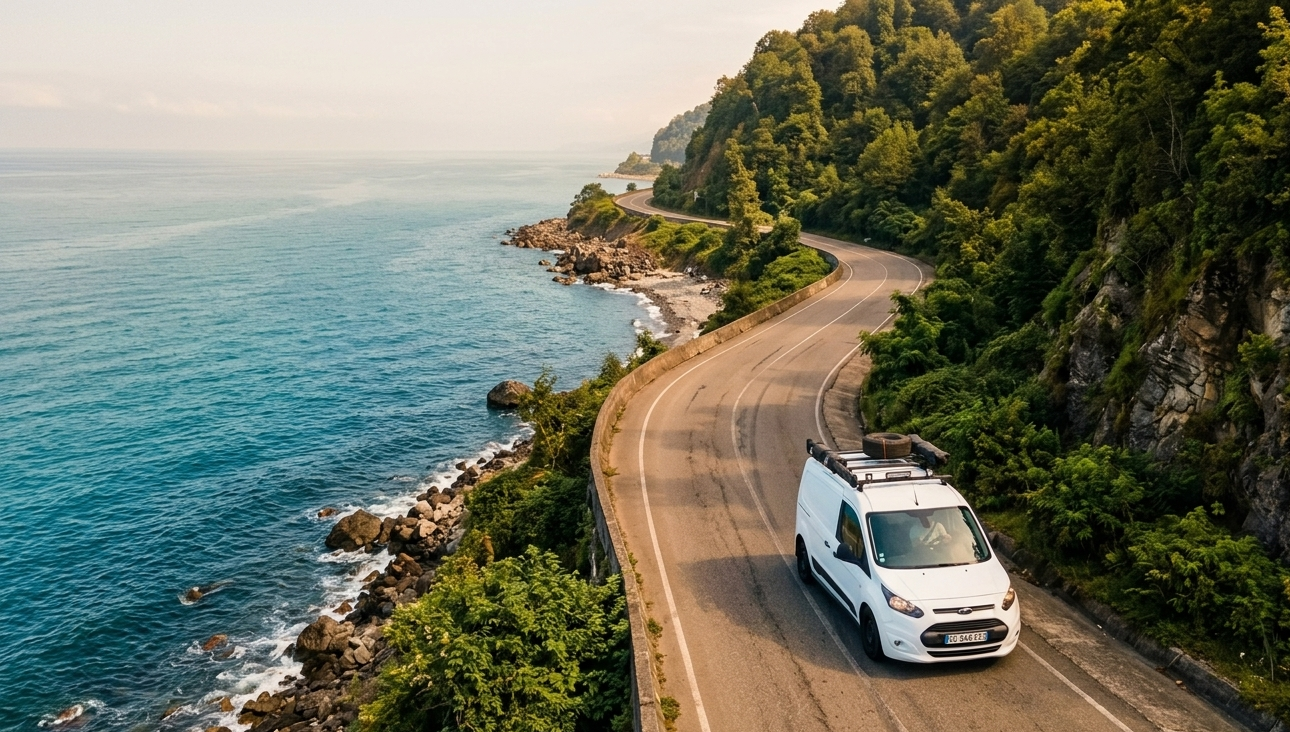
The drive from Kobuleti to Batumi takes less than half an hour. Take the coastal road rather than the highway — it runs directly along the sea, passing small fishing villages, beach bars, and the occasional roadside vendor selling fresh corn and sunflower seeds.
Batumi is unlike anywhere else in Georgia. A Black Sea port city with a skyline of improbable towers, a beautifully restored old town, a long seafront boulevard, and a botanical garden perched on a cliff above the sea. It’s the most international city in Georgia — a place where Georgian, Turkish, Russian, and more recently European influences have collided and produced something genuinely its own.
What to see in Batumi:
The Old Town — a compact area of restored 19th-century buildings, carved wooden balconies, and narrow streets leading to small squares. Walk it in the morning before it gets busy.
Batumi Boulevard — the long seafront promenade that stretches for several kilometres along the sea. Rent a bicycle, buy coffee, and watch the city go by.
Batumi Botanical Garden — established in 1912 on a hillside above the sea, with over 2,000 plant species from around the world. The views from the upper terraces down over the Black Sea are extraordinary. Allow two hours.
The Alphabet Tower — a landmark you’ll either love or find baffling. A 130-metre tower built in the shape of the Georgian alphabet’s letters, with a revolving restaurant at the top. Worth seeing from the outside at least.
Adjarian wine — the Adjara region around Batumi has its own wine culture, distinct from the better-known Kakheti wines of the east. Look for local Chkhaveri — a light, slightly tannic red — at wine bars in the old town.
Where to camp near Batumi: Wild camping directly in Batumi is difficult — the seafront is developed and busy. Instead, drive 10–15 km north of the city to the quieter coastal sections near Chakvi or Makhinjauri. There are beach access tracks that lead to open areas behind the pebble beach where overnight parking is undisturbed.
Alternatively, drive south of Batumi toward the Turkish border — the coast becomes quieter and more dramatic, with high cliffs and secluded coves.
Practical Information
Fuel Petrol stations are plentiful along the entire route. Fill up in Borjomi and Kutaisi before heading into smaller towns — stations get less frequent in rural areas.
Mobile signal Good throughout the main route. Signal drops in some mountain detours around Bakuriani and in the deeper gorges near Kutaisi. Download offline maps before you leave Tbilisi.
Road conditions The main E60 highway from Tbilisi to Batumi is well-paved and fast. Side roads to Bakuriani, the national park, and the monastery sites can be rough in places — all perfectly manageable in our vehicles. Ask us at pickup if you plan any specific detours.
Weather Western Georgia is significantly wetter than the east. The Black Sea coast and Kutaisi receive considerably more rainfall. Pack a waterproof layer regardless of the season. Summer (July–August) is warm and humid along the coast. May–June and September–October offer the best combination of good weather and fewer crowds.
Cash Carry Georgian Lari in cash for markets, roadside vendors, and smaller towns. Card payment is widely accepted in Kutaisi and Batumi but less reliable in rural areas.
Border crossing Batumi is close to the Turkish border at Sarpi. If you plan to continue into Turkey, discuss this with us at booking — cross-border travel requires prior agreement and additional documentation.
Before You Go
This route works beautifully in any vehicle in our fleet — but if you want to make the most of the wild camping spots along the way, the Ford Transit Connect Full Camper or the Ford Transit Full-Size Van will give you everything you need: a proper bed, a shower, and a kitchen to cook with.
Heading to the Black Sea? Book your vehicle here and let us know your plans at pickup — we’ll make sure you leave with everything you need for the western route.