Why Georgia Should Be Your Next Road Trip Destination
Ask someone in Western Europe where they’re going on holiday this summer and you’ll hear the same answers. Croatia. Portugal. Greece. The Greek islands again. The south of France, if they’re feeling ambitious.
Ask someone who’s been to Georgia and the conversation changes completely.
They’ll tell you about the mountain road that took their breath away. The family who invited them in for dinner and wouldn’t let them leave without trying three different homemade wines. The morning they woke up in a rooftop tent at 2,000 metres with nothing but peaks and silence in every direction. The meal that cost four euros and was the best thing they’d eaten in years.
Georgia does that to people. It gets under your skin in a way that the well-worn destinations of Europe rarely do anymore — because it’s still genuinely surprising. Still capable of giving you something you weren’t expecting.
And of all the ways to see it, a road trip by campervan is the best.
Here’s why.
The Landscape
Georgia is a small country — about the size of Ireland, or the state of South Carolina. But within that small space it contains more landscape variety than most countries ten times its size.
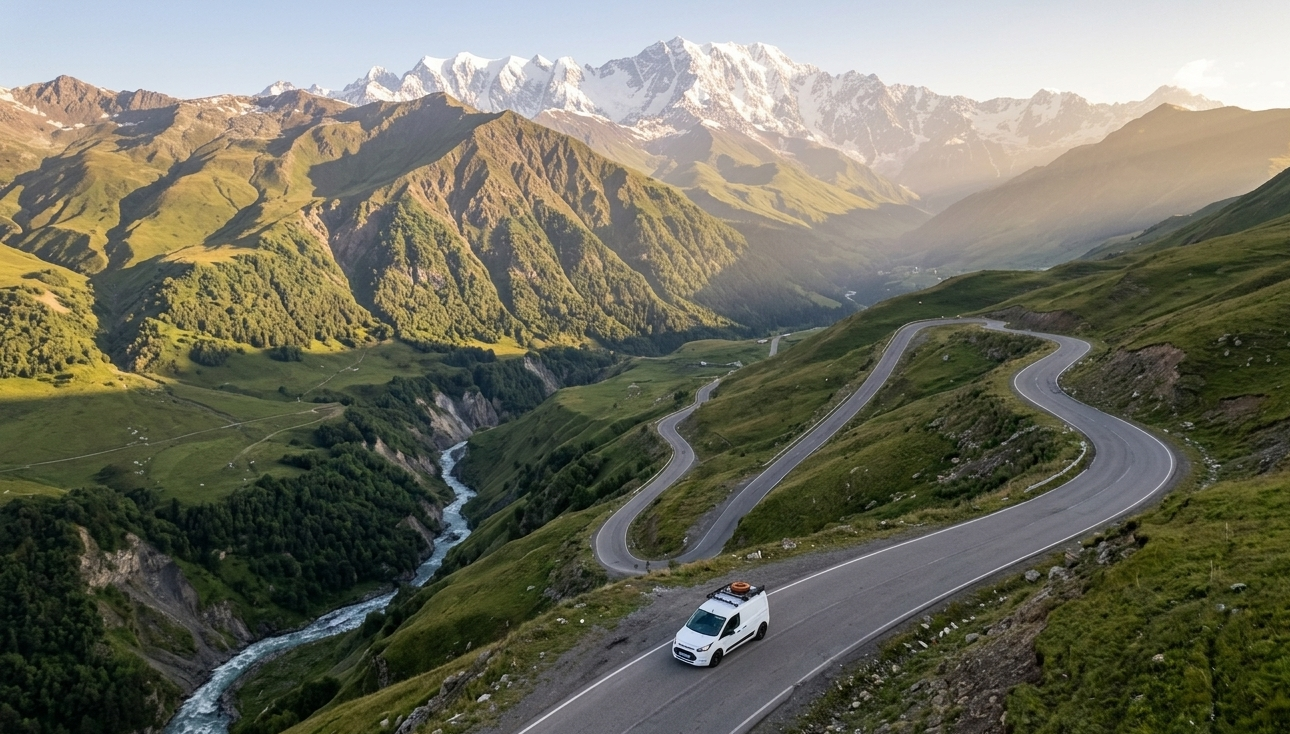
In the north, the Greater Caucasus mountain range forms one of the most dramatic natural borders on Earth. These are serious mountains — higher than the Alps, wilder, less developed, and astonishingly beautiful. The valleys that cut through them — Kazbegi, Svaneti, Tusheti — are the kind of places that make you question why you spent so many years going elsewhere.
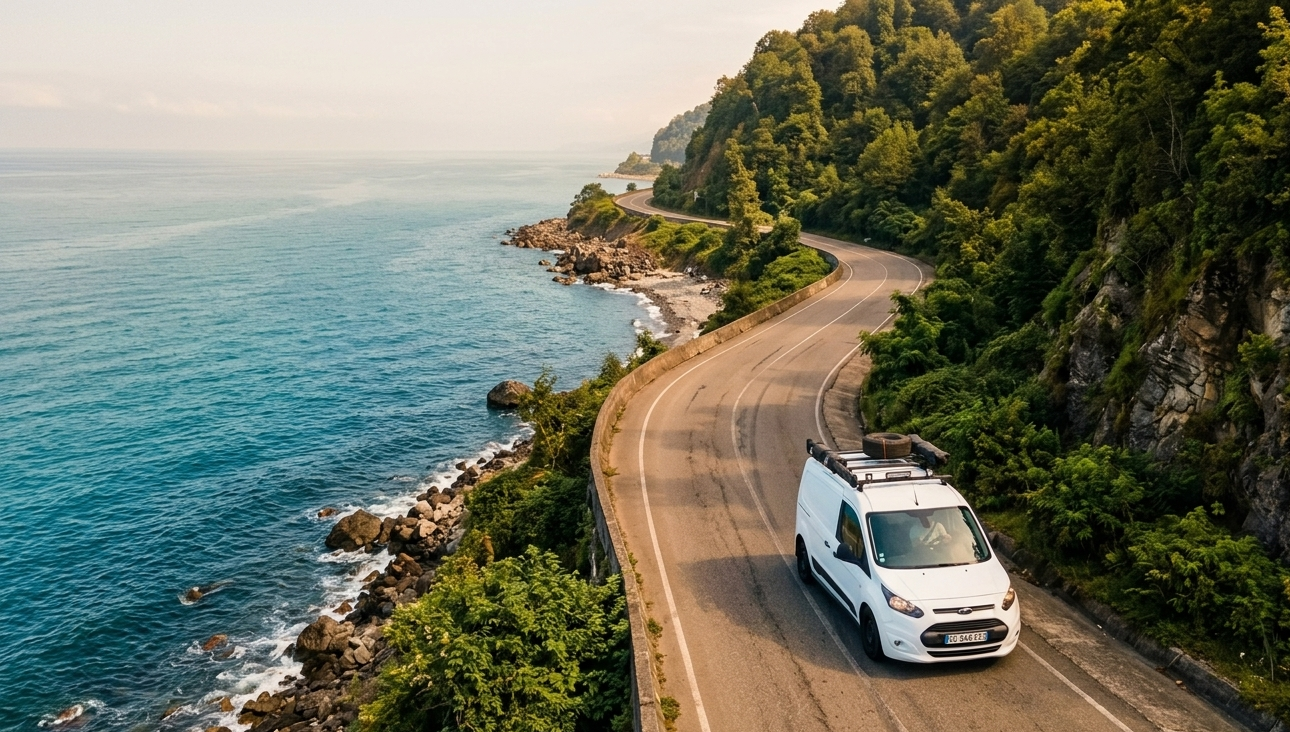
Drive west and the landscape softens entirely. The highlands give way to the lush, subtropical lowlands of western Georgia — dense forest, warm rain, and eventually the Black Sea coast, where palm trees and vineyards coexist at the edge of the water.
Head south and east and the country changes again. The wine region of Kakheti rolls out in golden waves of vineyard and wheat field, punctuated by medieval monasteries and ancient walled towns. Further south, past the rolling hills of Borjomi, the landscape turns to semi-desert — the canyon badlands of Vashlovani, where wolves and jackals roam and the only sound is the wind.
All of this is accessible by road. All of it in a single country. Most of it within a day’s drive of Tbilisi.
For a road tripper, Georgia is almost too good to be true.
The Roads
Georgia’s roads deserve their own section because they are, depending on where you go, either the best or the most memorable roads you will ever drive.
The main highways are well-maintained and fast. The Georgian Military Highway — the road north from Tbilisi to Kazbegi — is a genuine engineering marvel that winds through the Caucasus mountains with views that would make a Swiss driver weep with envy.
But the real roads are the ones that leave the main routes. The track up to a Svan tower village in the mountains. The switchback that climbs out of the Alazani valley into the Kakheti highlands. The dirt road along the Mtkvari River gorge that takes you somewhere with no name on the map and no other vehicles for hours.
Georgia has thousands of these roads. They are rough, sometimes genuinely challenging, always rewarding. And a well-equipped campervan is the perfect vehicle to explore them — giving you the freedom to follow the road wherever it goes and the comfort to stay wherever you end up.
One practical note: not all roads are suitable for all vehicles in all conditions. At Wolf Camp Georgia, we give honest advice at every pickup about which roads work for your chosen vehicle and your experience level. That conversation is part of what you’re renting.
The Food
Georgian cuisine is one of the great underrated food cultures of the world. It draws on influences from the Middle East, Persia, Russia, and the Mediterranean, filtered through centuries of its own tradition, and produces something entirely its own.
Khachapuri — Georgia’s most famous dish — is a boat-shaped bread filled with melted cheese and topped with a raw egg and a knob of butter. It sounds simple. It is simple. It is also extraordinary, and you will eat it every day without apology.
Khinkali are soup dumplings — thick dough parcels filled with spiced meat or mushrooms or cheese, sealed with a pleated top that you hold while you eat and leave on the plate like a small trophy. The rule is to eat them in one bite to capture the broth inside. The rule is frequently broken by first-timers. This is fine.
Badrijani nigvzit — sliced aubergine rolled around a walnut and garlic paste, served cold. One of the great vegetable dishes of the world.
Churchkhela — strings of walnuts dipped in concentrated grape juice and dried, sold in every market and roadside stall across the country. The Georgian energy bar. Eat them by the handful.
Lobiani — flatbread stuffed with spiced kidney beans. The thing you eat at a roadside bakery at seven in the morning when you’ve been driving since dawn and you need something warm and filling and costing less than a euro.
The food culture in Georgia is deeply tied to hospitality — the concept of supra, a Georgian feast presided over by a tamada (toastmaster), is one of the most joyful social rituals you’ll encounter anywhere in the world. If you are invited to one, cancel your plans and go.
Eating well in Georgia requires almost no effort and very little money. A full meal for two people at a good restaurant in Kutaisi or Sighnaghi — including wine — will rarely cost more than fifteen euros. A market breakfast of fresh bread, local cheese, and tomatoes costs almost nothing.
For campervan travelers, the combination of local markets, roadside bakeries, and your own kitchen means you can eat extraordinarily well for very little. Stock up at every market you pass. Cook in the evening. Eat well.
The Wine
Georgia is, by most accounts, the birthplace of wine. Archaeological evidence of winemaking here dates back 8,000 years — predating the wines of France, Italy, and Spain by millennia.
Georgian wine is made using the traditional qvevri method — fermenting and aging the wine in large clay vessels buried underground, sometimes with the grape skins left in contact with the juice for months. The result is what the wine world now calls orange wine — amber-coloured, deeply complex, with a tannic structure unlike anything produced by conventional winemaking.
The wine region of Kakheti in eastern Georgia produces the majority of the country’s wine, and a road trip through the valley in autumn — harvest season — is one of the great travel experiences the Caucasus has to offer. Pull off the road at a family winery. They will pour you wine. They will offer you food. They will want to know where you’re from and where you’re going. The conversation will last longer than you planned. This is Georgia working as intended.
Beyond Kakheti, every region has its own wine culture. The Adjara region around Batumi produces the light, distinctive Chkhaveri. Racha in the northwest makes the slightly sweet Khvanchkara — famously said to have been Stalin’s favourite. Imereti produces amber wines of extraordinary depth.
For the road-tripper, Georgia’s wine culture is not a detour — it is part of the road itself.
The People
This is the part that’s hardest to explain to someone who hasn’t been, and the part that every returned traveler mentions first.
Georgian hospitality is not a tourist industry invention. It is a deeply held cultural value — the belief, encoded in the language and the social fabric, that a guest is a gift from God. Stumari ghvtis survilia — the guest is sent by God. This is not a metaphor. It is how many Georgians genuinely feel about the people who arrive at their door.
What this means in practice: you will be invited into homes. You will be offered food and wine by people who have just met you. You will be given directions with a level of care that borders on the personal. You will be helped when you don’t ask for help and thanked when you didn’t do much.
None of this is performance. It is just how things are.
Traveling by campervan amplifies this. You are visible — a vehicle with a tent on the roof, parked in a field or a village square, is an invitation for curiosity. People will approach you. They will want to know who you are and what you’re doing. These conversations are among the best things that happen on a Georgian road trip.
The Price
Let’s be direct about this, because it matters.
Georgia is one of the most affordable travel destinations in Europe and the broader Caucasus region. For travelers from Western Europe, North America, or Australia, the difference in cost of living is significant enough to genuinely change how you travel.
A good meal for two with wine: €10–15. A coffee and pastry at a Tbilisi café: €2–3. A litre of fuel: approximately €0.90–1.00. Entry to most historical sites and national parks: €1–5, often free. A bottle of excellent local wine from a supermarket: €4–8.
For campervan travelers specifically, the cost advantages compound. Wild camping is free and widely practiced. Local markets provide excellent, cheap food. The distances involved are short enough that fuel costs remain low. A week-long campervan trip in Georgia — properly done, sleeping wild, eating local — is achievable at a fraction of the cost of an equivalent trip in Western Europe.
This does not mean Georgia feels cheap. It means it feels like extraordinary value. There is a difference.
The Timing
Georgia is a year-round destination but the road-trip season runs from April to October.
April–May is perhaps the best time of year — the mountains are snow-capped but the lower roads are clear, the landscape is intensely green, the wildflowers are out, and the tourist crowds haven’t arrived yet. Temperatures are mild and the light is exceptional.
June–August is high season — warm everywhere, hot in Tbilisi and the east, busy along the Black Sea coast. The mountains are at their most accessible. Book your vehicle early.
September–October is harvest season in Kakheti — one of the great times to be in Georgia. The vineyards turn gold, the air is clear, the temperatures perfect. Arguably the finest time of year to road trip the country.
November–March brings snow to the mountains and cold to Tbilisi. Some high-altitude roads close entirely. The country is quiet, prices drop further, and Tbilisi in winter has its own atmospheric appeal — but this is not ideal campervan territory unless you are specifically equipped and experienced.
How to Get There
Tbilisi International Airport receives direct flights from most major European cities — London, Paris, Berlin, Amsterdam, Warsaw, Vienna, and many more. Flight times from central Europe are typically 3–4 hours. From the UK, around 5 hours.
Budget airlines serve Tbilisi regularly, and return flights from Western Europe can often be found for €150–250 with some advance planning.
Land borders with Turkey (at Batumi and Akhaltsikhe), Armenia, and Azerbaijan are also open and well-traveled.
Once you arrive, pick up your campervan from our Tbilisi base and the country is yours.
The Case, In Summary
Georgia gives you dramatic mountain landscapes, subtropical coastline, ancient desert canyons, and rolling wine country — all within a single country and a few days’ drive. It feeds you extraordinarily well for almost nothing. It pours you wine that has been made here for eight thousand years. It welcomes you with a warmth that feels entirely genuine because it is. And it gives you roads — real roads, interesting roads, roads that go somewhere worth going.
It is, in every sense that matters for a road tripper, a perfect destination.
The only question is which vehicle you want to take.